But the biggest question is not:
“How much AI can we deploy?”
It is:
“Can our operating model absorb and exploit it?”
- AI agents can automate tasks.
- AI can connect knowledge.
- AI can accelerate decisions.
But if value streams remain fragmented, enabling capabilities remain weak, and decision rights remain locked in silos, AI will simply make parts of the existing system faster.
Faster is not always better.
The enterprise needs an operating model designed for adaptation.
One where:
→ Value streams are visible end-to-end
→ Business capabilities enable those value streams
→ People and AI can work together
→ Data and technology can move across boundaries
→ Governance and security are built into execution
→ Decision rights can evolve as capabilities change
This creates a different relationship between AI and the enterprise:
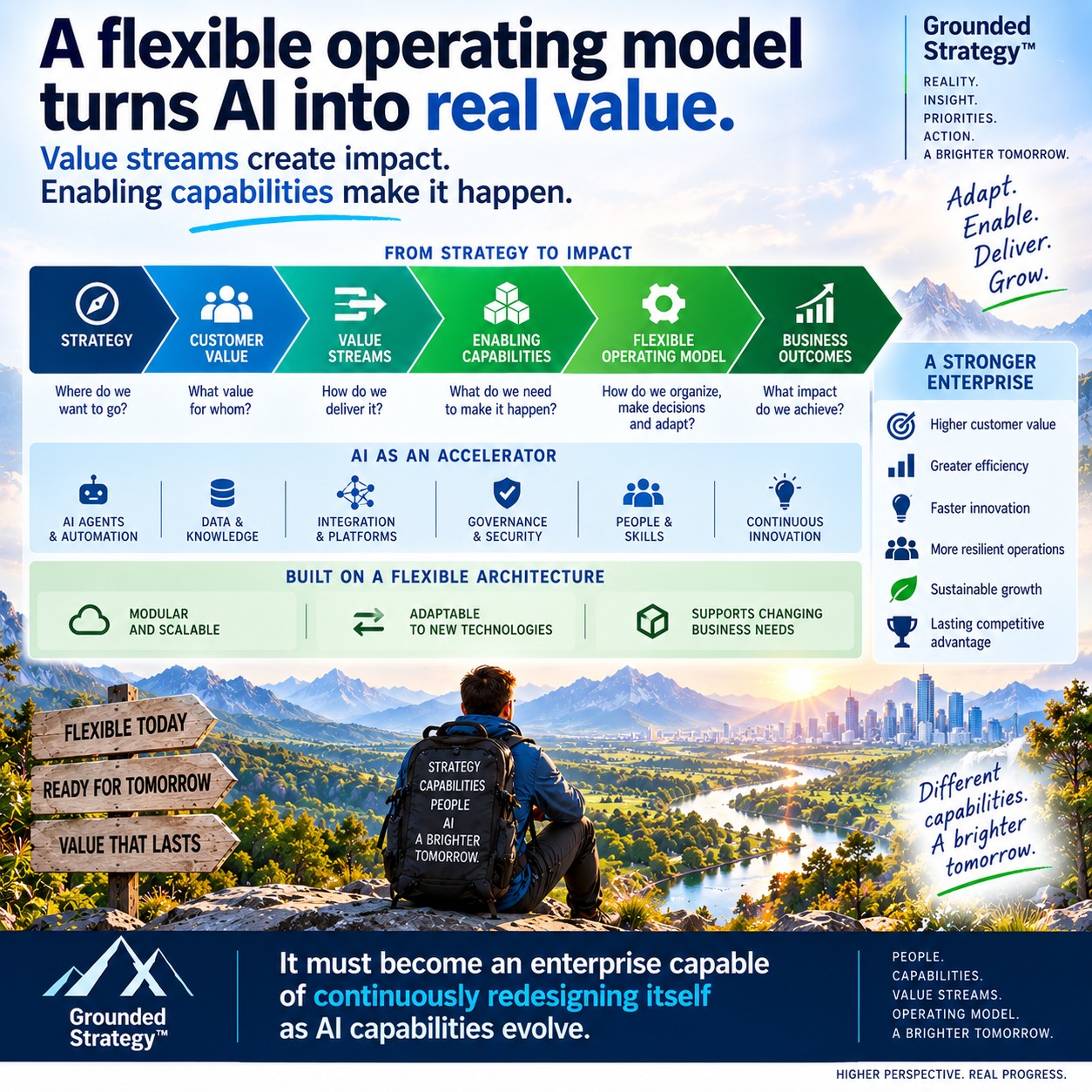
Strategy → Customer Value → Value Streams → Enabling Capabilities → Operating Model → Business Outcomes
AI becomes an accelerator—not the operating model itself.
And this is where Business Architecture becomes critical.
It provides the connection between what the enterprise wants to achieve and how the enterprise must work differently to achieve it.
The goal is not to build an AI-enabled version of yesterday’s organization.
The goal is to build an enterprise that can adapt faster than yesterday’s organization ever could.
Flexible today.
Ready for tomorrow.
Built for lasting value.
And ultimately:
It must become an enterprise capable of continuously redesigning itself as AI capabilities evolve.
#AI #BusinessArchitecture #OperatingModel #ValueStreams #BusinessCapabilities #AIAgents #BusinessTransformation #Strategy #CompetitiveAdvantage #GroundedStrategy