
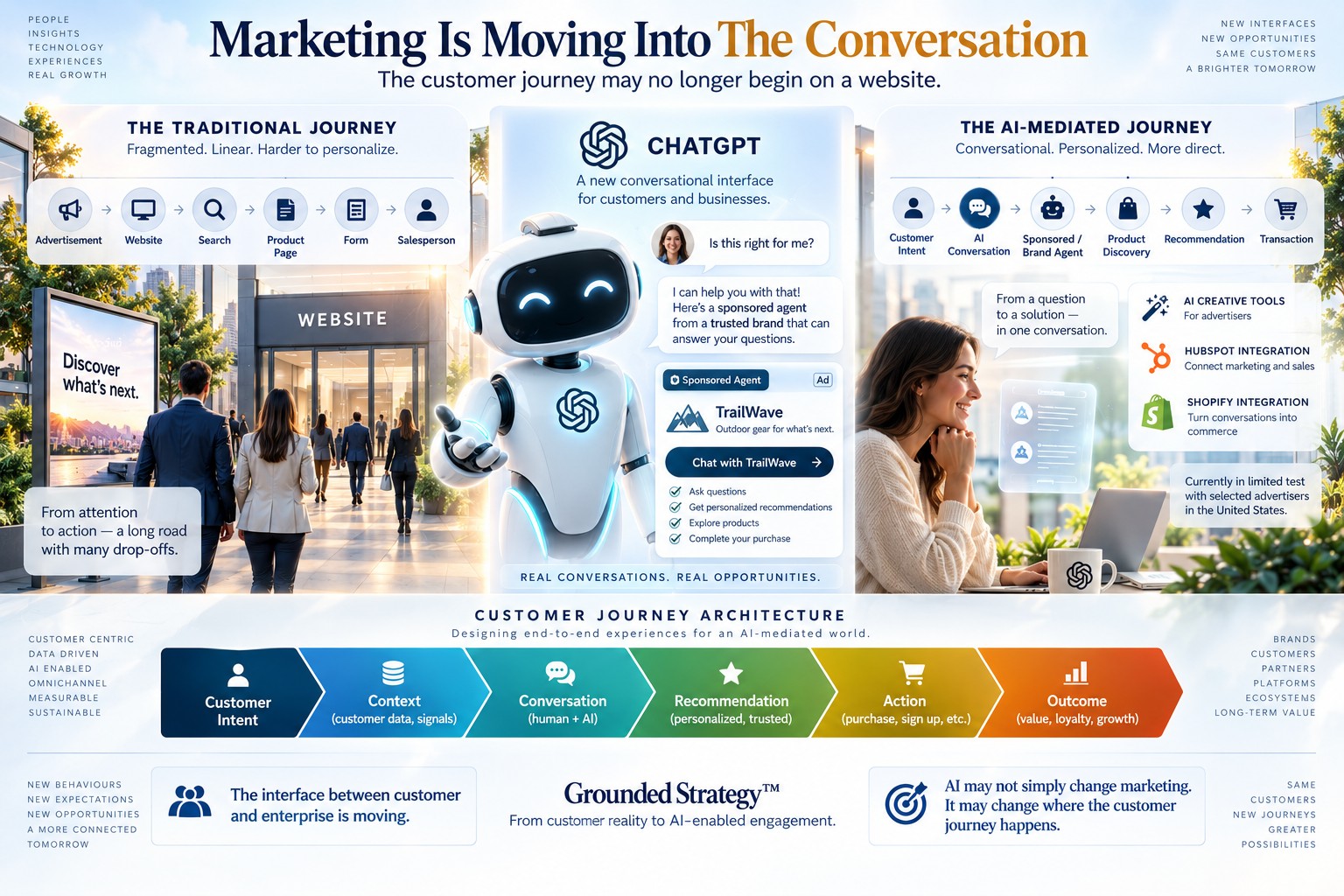
For decades, digital marketing has been built around a relatively simple architecture.
A company creates an advertisement.
The customer clicks.
The customer is moved to a website.
Then perhaps to search, a product page, a form, a salesperson or a checkout process.
The architecture looks familiar:
Advertisement → Website → Search → Product Page → Form → Salesperson/Commerce platform
The customer journey is therefore distributed across multiple interfaces.
- The advertisement creates attention.
- The website provides information.
- Search helps the customer find something specific.
- The product page supports evaluation.
- The form captures intent.
- The salesperson or commerce platform completes the next stage.
But what happens when the customer can remain inside the conversation from the moment intent appears?
That is the strategic question raised by OpenAI’s latest advertising developments.
From advertising to conversation
On September 16, 2026, OpenAI announced new AI-powered experiences for ChatGPT Ads, including Sponsored Agents.
The concept is straightforward: after interacting with an ad, a user can choose to start a clearly labeled conversation with a business-sponsored agent in ChatGPT. The customer can ask questions, explore the offering and, when ready, follow a link to the business website.
OpenAI also announced integrations with HubSpot and Shopify to connect advertising activity with existing CRM and ecommerce workflows. Sponsored Agents are currently being tested with selected advertisers in the United States.
Technically, this is an advertising development.
Strategically, it may be something bigger.
It potentially changes where the customer journey happens.
The traditional architecture
The traditional digital marketing journey might look like this:
Advertisement
↓
Website
↓
Search
↓
Product Page
↓
Lead Form
↓
Salesperson / Commerce
↓
Transaction
Every transition introduces friction.
The customer has to move from one interface to another.
They may have to repeat their question.
They may have to search again.
They may have to compare information themselves.
They may have to determine whether the information on one page is consistent with another.
Marketing therefore creates the initial connection, but much of the actual decision-making journey takes place somewhere else.
That architecture has worked for decades.
AI introduces another possibility.
The AI-mediated journey
Now consider:
Customer Intent
↓
AI Conversation
↓
Sponsored / Brand Agent
↓
Product Discovery
↓
Recommendation
↓
Action
The difference is not merely that AI has been inserted into the journey.
The interface itself has changed.
Instead of navigating through a sequence of pages, the customer can express intent directly.
Instead of reading a product description, the customer can ask a question.
Instead of comparing specifications manually, the customer can ask for help understanding the differences.
Instead of moving immediately to a generic sales form, the customer can continue a contextual conversation.
The customer journey becomes more conversational.
And that creates a profound change for marketing.
Marketing becomes partly a conversation-design discipline
Traditional advertising is fundamentally about communication.
The brand says something.
The customer receives the message.
AI-mediated marketing introduces a second dimension:
the brand must participate in the conversation that follows.
That means marketing may increasingly have to think about questions such as:
- What does the AI know about our products?
- What does it know about our customers?
- How should it interpret customer intent?
- Which recommendations are appropriate?
- Which claims can it make?
- What policies must it respect?
- When should it ask a clarifying question?
- When should it recommend a human?
- When should it stop?
This means that the quality of the customer experience no longer depends only on the creative quality of the advertisement.
It also depends on the quality of the enterprise knowledge and decision logic behind the conversation.
That is where marketing starts to intersect with Business Architecture.
From message architecture to journey architecture
Marketing organizations have traditionally designed:
Audience → Message → Channel → Campaign → Conversion
But an AI-mediated environment adds:
Intent → Context → Conversation → Recommendation → Action
This requires the organization to think about the complete journey rather than just the campaign.
A customer may begin with a simple question:
“Is this product right for me?”
The answer might require knowledge from multiple parts of the enterprise:
- Product information.
- Pricing
- Customer segment rules.
- Availability
- Promotions
- Service policies.
- Returns
- Delivery
- Customer history.
- Risk rules.
Even organizational decision rights.
Suddenly, the AI interaction is no longer merely a marketing problem.
It becomes an enterprise integration problem.
The agent becomes a participant in the customer journey
This may be the most important strategic change.
Historically, the customer journey has included:
Customers → Employees → Channels → Systems → Products
AI introduces another participant:
Customers → AI Agents → Employees → Systems → Products
And the AI agent may sit between customer intent and enterprise execution.
That changes the architecture.
A customer-facing AI agent needs to understand:
Context
What is relevant about the customer and the situation?
Business meaning
What does the customer actually need?
Capabilities
What can the enterprise provide?
Processes
How does the enterprise fulfil the request?
Rules
What constraints apply?
Decision rights
What can the AI decide, and what requires human authority?
Action
What can the system actually execute?
This is the same fundamental distinction we have been exploring in Grounded Strategy™:
AI intelligence is not the same as enterprise understanding.
A highly capable model can generate an excellent answer.
An enterprise agent needs to generate an answer that is correct for this enterprise, this customer, this context and this point in the journey.
The marketing operating model may change
This also raises an important organizational question.
Who owns the customer-facing AI experience?
- Marketing?
- Digital?
- Customer Experience?
- IT?
- Sales?
- Product?
- Customer Service?
- Data?
The obvious answer may be:
Everyone — but through a coherent architecture.
Because the customer does not experience organizational boundaries.
The customer experiences one conversation.
Marketing may own the message.
Product may own the offering.
Customer Service may own policies.
Sales may own commercial decisions.
IT may own the platform.
Data teams may own the information.
Risk may own controls.
But the AI agent potentially sits across all of them.
That means organizations may need to rethink the customer journey as an end-to-end business architecture, not merely a marketing funnel.
A new marketing question
For decades, marketers have asked:
How do we get the customer to our website?
AI may create a different question:
What if the customer does not need to come to our website first?
That does not mean websites disappear.
It means the website may no longer be the only—or always the first—digital interface between customer and enterprise.
The customer may begin with a conversation.
The conversation may establish intent.
The AI may help with discovery.
A brand-sponsored agent may answer questions.
The customer may receive a recommendation.
Then the journey can continue into commerce, CRM, service or a human interaction.
The interface is becoming fluid.
The new customer journey architecture
This suggests an emerging model:
Customer Intent
↓
Context
↓
Conversation
↓
Recommendation
↓
Action
↓
Outcome
↓
Learning
This is much closer to a continuous customer relationship than a conventional advertising funnel.
And the final stage matters enormously.
The interaction produces information about what the customer wanted, where they hesitated, what they asked about and what prevented action.
That can feed back into:
- Product strategy.
- Marketing strategy.
- Customer experience.
- Capability development.
- Journey redesign.
- AI improvement.
The customer journey therefore becomes not only a path to conversion.
It becomes a learning system.
What happens to advertising?
Advertising does not disappear.
But its role may evolve.
Today, advertising often tries to create curiosity.
In an AI-mediated environment, advertising may create the opening for a conversation.
That changes the value proposition.
The ad says:
“Here is something you may care about.”
The AI experience can continue:
“Tell me what matters to you.”
That is a fundamental shift.
The first is broadcasting.
The second is interaction.
And interaction creates a very different relationship with the customer.
The strategic question
The most important question is therefore not:
“Will
ChatGPT become another advertising channel?”
Of course, it can be.
The more important question is:
“What happens to the customer journey when the advertising interface can also become the conversational interface?”
That is where the real strategic significance lies.
Because the boundary between:
Marketing
Customer Experience
Sales
Commerce
Customer Service
and
AI
starts to become much less clear.
The interface between customer and enterprise is moving.
And when the interface moves, the architecture behind it has to move as well.
The Grounded Strategy™ perspective
I see the emerging structure as:
Customer Reality
↓
Intent
↓
Context
↓
Business Meaning
↓
Enterprise Capabilities
↓
AI Conversation
↓
Recommendation
↓
Decision
↓
Action
↓
Business Outcome
↓
Learning & Evolution
This is not simply a new advertising funnel.
It is a new customer-enterprise interaction architecture.
And that may be the most important marketing story hidden inside the arrival of Sponsored Agents.
AI may not simply change marketing.
It may change where the customer journey happens.
Grounded Strategy™
From customer reality to AI-enabled engagement.