How AI Is Changing the Enterprise Finance Operating Model
For years, enterprise technology has largely followed a familiar pattern.
Companies implemented ERP systems.
They built databases.
They connected applications.
They created reporting layers.
Finance teams processed transactions, reconciled accounts, prepared reports, performed controls and consolidated information for management.
Then AI arrived.
At first, it looked like another technology layer.
A better way to search.
A better chatbot.
A better forecasting model.
A better way to automate individual tasks.
But something much more important is now happening.
AI is beginning to connect intelligence directly to enterprise systems and business processes.
The interesting question is therefore no longer:
“What can the AI model do?”
It is:
“What happens when AI can understand enterprise data, interact with business applications and participate directly in the execution of business processes?”
That is where the transformation becomes much more significant.
-
The journey starts with AI models
Today’s enterprise can access multiple forms of AI intelligence.
General-purpose foundation models.
Specialized reasoning models.
Coding models.
Financial models.
Domain-specific models.
Smaller, cheaper models optimized for particular tasks.
The enterprise therefore does not necessarily need to build everything around one model.
Instead, an emerging architecture looks more like:
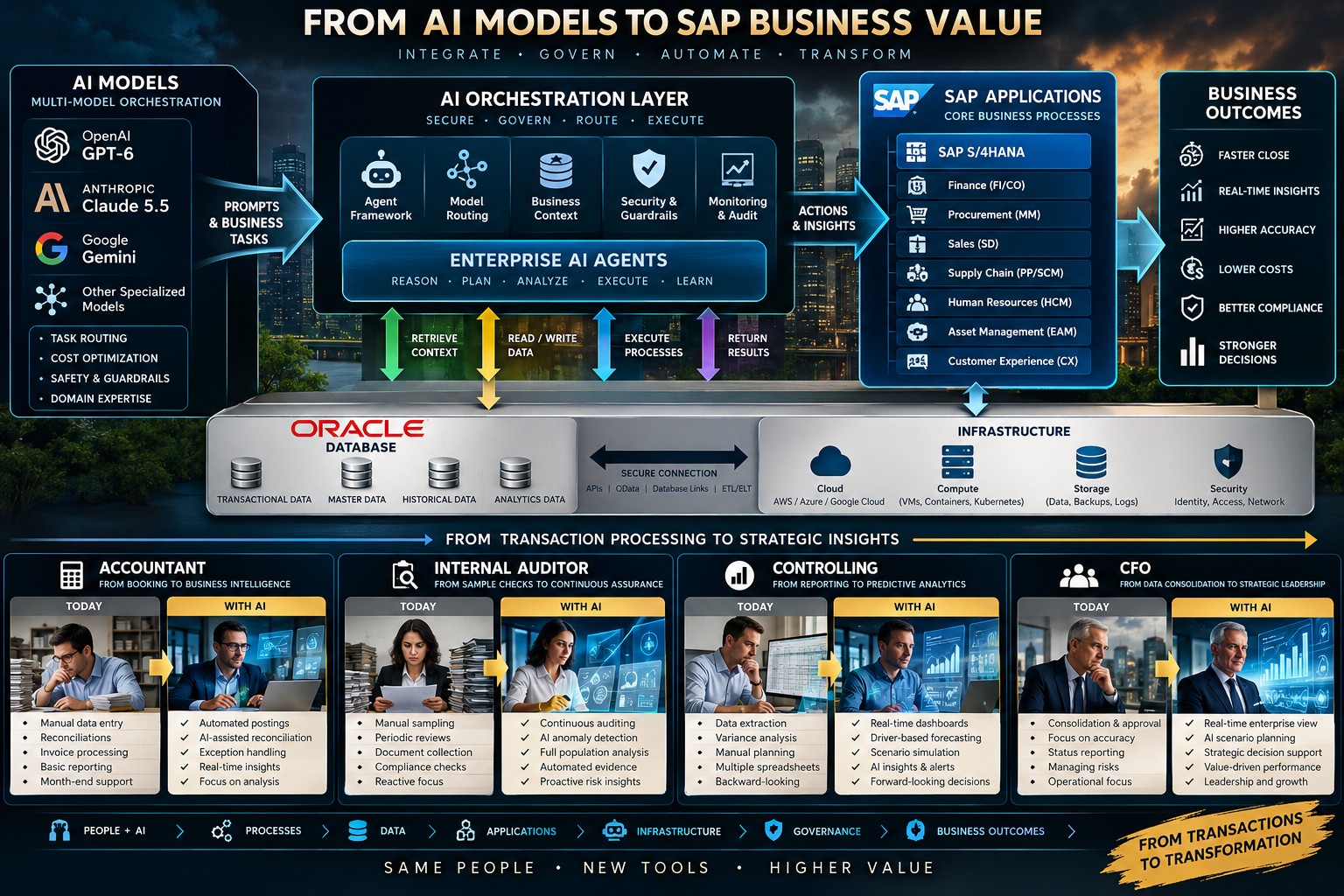
AI Models → Model Routing → AI Agents → Enterprise Context → Business Applications → Business Outcomes
Different tasks can use different models.
A routine classification task may require relatively little intelligence.
A complex financial analysis may require a stronger reasoning model.
A highly sensitive process may require additional controls, human approval or a specialized model.
This means that model selection itself becomes an architectural decision.
The enterprise must consider:
- capability
- cost
- latency
- security
- reliability
- data requirements
- regulatory constraints
- business risk
The question becomes:
Which intelligence is appropriate for which business capability?
-
But intelligence alone is not enough
This is where the story becomes much more interesting.
A powerful AI model can understand accounting concepts.
It can understand procurement.
It can understand financial statements.
It can reason about anomalies.
But that does not necessarily mean it understands how your company actually works.
Consider a simple example.
An AI model may know that an invoice normally requires a purchase order, goods receipt and appropriate approval.
But an enterprise may have its own specific rules:
- different approval thresholds,
- different treatment for strategic suppliers,
- different rules by country,
- different exceptions,
- different segregation-of-duties requirements,
- different accounting policies,
- different decision rights.
The model needs more than information.
It needs enterprise context.
This is the distinction I find increasingly important:
AI intelligence ≠ enterprise understanding.
Enterprise AI therefore needs a bridge between general intelligence and the specific reality of the organization.
That bridge includes:
Enterprise Context → Business Meaning → Capabilities → Processes → Rules → Decisions
Only then can AI move reliably toward action.
-
From context to SAP
This is where enterprise applications such as SAP become particularly important.
An ERP system is not simply a database containing transactions.
It contains business processes, rules, master data, workflows, permissions, organizational structures and decision logic.
Think about the finance domain.
SAP may contain:
- accounts payable,
- accounts receivable,
- general ledger,
- controlling,
- procurement,
- asset management,
- supply chain information,
- sales information,
- organizational structures,
- approval workflows.
This creates an enormous opportunity.
Instead of AI simply producing a recommendation in a separate interface, an AI agent can potentially interact with the systems where the business actually operates.
The architecture begins to look like:
AI Model
↓
AI Orchestration / Agent Layer
↓
Enterprise Context
↓
SAP Applications
↓
Business Process
↓
Business Outcome
The AI is no longer merely answering a question.
It can become part of the execution environment.
-
And then we reach the data layer
There is another critical component underneath this architecture:
Data.
Enterprise data may reside across databases, applications, data warehouses, cloud platforms and specialized systems.
In many enterprises, Oracle databases and other data platforms contain enormous amounts of transactional, historical and analytical information.
But again, data alone is not enough.
An agent needs to understand:
What does the data mean?
Which definition is authoritative?
Which data is current?
How does one data object relate to another?
What business rule applies?
Who is allowed to use it?
What decision can be made from it?
This is why I increasingly see the enterprise data layer as more than a technical foundation.
It becomes part of the enterprise’s AI context architecture.
The progression is:
Data → Meaning → Context → Intelligence → Decision → Action
And this is one reason why Business Architecture and Data Architecture become increasingly connected in an AI-enabled enterprise.
-
Infrastructure becomes part of the strategic equation
Underneath everything sits infrastructure.
Compute.
Cloud.
Storage.
Networks.
Security.
Identity.
Containers.
Specialized AI infrastructure.
Not every enterprise will own these components.
Some will consume cloud services.
Some will operate private infrastructure.
Some will use hybrid architectures.
Some will rely heavily on technology partners.
The important point is not ownership.
It is understanding dependency.
The enterprise needs to understand how infrastructure affects:
- cost,
- resilience,
- performance,
- security,
- scalability,
- data sovereignty,
- model availability,
- business continuity.
This is why I like the architecture:
From Infrastructure to Business Outcome
The enterprise does not need to own every layer.
But it needs to understand how the layers connect.
-
Then something even more important happens: the work changes
Technology transformation becomes business transformation when people’s work changes.
Consider four familiar finance roles.
The Accountant
The traditional role contains substantial transaction-oriented work:
data entry → reconciliations → invoice processing → postings → month-end support → reporting
AI can increasingly assist with:
automated postings → AI-assisted reconciliation → exception identification → real-time analysis → anomaly detection
The role does not necessarily disappear.
The center of gravity can move.
From:
“Process the transaction.”
toward:
“Understand the exception and the business implication.”
That is a different job.
-
The Internal Auditor
Internal audit provides another powerful example.
Traditional activities can include:
sample selection → document collection → periodic testing → compliance checks → manual evidence review
AI can potentially support:
continuous monitoring → anomaly detection → broader population analysis → automated evidence collection → proactive risk identification
This changes the fundamental question.
Instead of:
“What sample should I test?”
the auditor may increasingly ask:
“What unusual pattern requires my professional judgment?”
That is not less professional work.
It can mean more judgment and less mechanical testing.
But it also creates a new requirement:
The auditor needs to understand how AI itself operates.
What data did the system use?
What rules were applied?
What model was used?
What controls existed?
What exceptions were generated?
What evidence supports the conclusion?
AI therefore becomes both:
a tool for audit
and
an object of assurance.
-
Controlling moves from reporting toward prediction
The controller’s role can also change significantly.
Traditional controlling often involves:
data extraction → variance analysis → spreadsheets → reporting → planning → management packs
AI-enabled controlling can move toward:
real-time dashboards → driver-based forecasting → scenario simulation → anomaly alerts → predictive analysis → forward-looking decisions
The difference is subtle but important.
Traditional reporting asks:
“What happened?”
AI-enabled controlling can increasingly ask:
“What is changing?”
and:
“What is likely to happen next?”
and eventually:
“Which intervention could change the outcome?”
That is a significant shift from backward-looking reporting toward forward-looking decision support.
-
And what happens to the CFO?
This may be the most interesting part.
The CFO has traditionally needed to consolidate information, challenge assumptions, understand financial performance, manage risk and support strategic decisions.
AI can potentially reduce the time required to assemble and interpret information.
That creates the possibility of moving from:
data consolidation → reporting → explanation
toward:
real-time enterprise view → scenario analysis → risk intelligence → strategic decision support
The CFO does not become less important because information becomes easier to access.
The opposite may happen.
When information becomes abundant, judgment becomes more valuable.
The CFO’s question may increasingly become:
“Given what we now know, what should the enterprise do?”
That is a strategic question.
And it cannot simply be delegated to a model.
-
The real transformation is therefore not job replacement
This is where I would be careful about the popular narrative.
The future is unlikely to be as simple as:
AI replaces accountant.
AI replaces auditor.
AI replaces controller.
AI replaces CFO.
The more interesting possibility is:
AI changes the composition of the work.
Routine work becomes increasingly automated.
Exceptions become more important.
Judgment becomes more important.
Business understanding becomes more important.
AI supervision becomes more important.
Governance becomes more important.
Strategic interpretation becomes more important.
The professional may therefore move up the value chain.
From:
Transactions
to:
Exceptions
to:
Insights
to:
Decisions
to:
Strategic Value
-
This is where Business Architecture becomes critical
None of this happens simply because an enterprise buys an AI model.
Someone has to understand:
Which capabilities should change?
Which processes should be redesigned?
Which decisions can be delegated?
Which decisions must remain human?
Which data is required?
Which systems must be connected?
Which controls must be embedded?
Which roles must evolve?
How should the operating model change?
This is Business Architecture territory.
The transformation therefore becomes:
Strategy
What outcome are we trying to achieve?
↓
Business Architecture
Which capabilities and value streams must change?
↓
Operating Model
How should people, AI and systems work together?
↓
AI Architecture
Which models and agents should perform which work?
↓
Enterprise Data & Application Architecture
Where does context come from and where does action occur?
↓
Governance
What authority and controls are required?
↓
Execution
How does the new model actually operate?
↓
Outcome
Did the enterprise become better?
-
The architecture is bigger than SAP
SAP is an important part of this picture.
Oracle can be part of it.
Cloud infrastructure can be part of it.
AI models can be part of it.
Agents can be part of it.
But none of these components alone creates transformation.
The strategic asset is the connection between them.
Infrastructure
provides the foundation.
AI models
provide intelligence.
Data
provides information and context.
Enterprise applications
provide business processes and systems of record.
AI agents
provide increasingly autonomous execution.
Governance
provides authority and boundaries.
Business Architecture
connects all of these elements to enterprise capabilities and strategic intent.
Operating Model
determines how people and AI actually work together.
Business outcomes
determine whether the transformation created value.
-
From transaction processing to transformation
This is ultimately the transition I find most interesting.
For decades, enterprise systems helped organizations process the business.
AI may increasingly help organizations understand, decide and change the business.
That is a fundamentally different role.
The journey becomes:
Transaction Processing
↓
Automation
↓
AI-Assisted Execution
↓
AI-Assisted Decision Making
↓
Continuous Intelligence
↓
Continuous Business Improvement
And eventually:
The enterprise begins to redesign itself around continuously improving intelligence and capabilities.
That is much bigger than implementing an AI assistant.
-
The Grounded Strategy™ perspective
This is one of the reasons Grounded Strategy™ was created.
The starting point should not be:
“Where can we put AI?”
The starting point should be:
“What is the enterprise trying to achieve, how does it operate today, where are the capability and value gaps, and where can AI create measurable improvement?”
The sequence becomes:
Understand
What exists today?
Analyze
Where are the strategic, capability and process gaps?
Prioritize
Which changes deserve scarce investment capacity?
Redesign
How must the capability, value stream and operating model evolve?
AI-enable
Which AI capabilities should be introduced?
Validate
Did the enterprise actually create better outcomes?
And then:
Learn → Adapt → Evolve
That final loop is essential.
Because AI will continue to change.
Models will improve.
Costs will fall.
New agents will appear.
Enterprise applications will evolve.
Infrastructure will change.
Therefore the enterprise itself must become capable of continuous redesign.
The real question
The future question is not:
“Will AI replace finance professionals?”
It is more interesting:
“How will finance work when AI becomes part of the enterprise operating model?”
And the answer may be:
Less transaction processing.
Less manual reconciliation.
Less periodic sampling.
Less spreadsheet consolidation.
And potentially:
More exception management.
More continuous assurance.
More predictive analysis.
More scenario planning.
More strategic judgment.
More business partnership.
The technology may change the tools.
But the deeper transformation is in what the enterprise considers valuable human work.
From AI Models to Business Value
The complete journey can therefore be expressed simply:
AI Models
→ AI Orchestration
→ Enterprise Context
→ Data & Applications
→ AI Agents
→ Governed Business Processes
→ Business Capabilities
→ Human + AI Operating Model
→ Business Outcomes
The future enterprise will not simply be one that uses AI.
It will be one that knows where AI belongs, how AI should operate, what authority AI should have, where humans must remain accountable, and how the resulting capability creates measurable business value.
That is the real transformation.
From transactions to transformation.
From information to intelligence.
From intelligence to action.
From action to business value.
And ultimately:
The strategic advantage will belong to enterprises capable of continuously redesigning themselves as AI capabilities evolve.
Grounded Strategy™
From Enterprise Reality to AI-Enabled Action.
#AI #AIGovernance #BusinessArchitecture #AgenticAI #EnterpriseAI #SAP #CFO