Why can a very intelligent AI agent still fail inside a company?
Because intelligence is not the same as understanding how the enterprise actually works.
Pinecone’s CEO Edo Liberty highlights an increasingly important problem with enterprise AI: agents can fail not because the underlying models lack intelligence, but because they lack the organizational knowledge and context required to operate effectively inside a real company.
And this distinction matters.
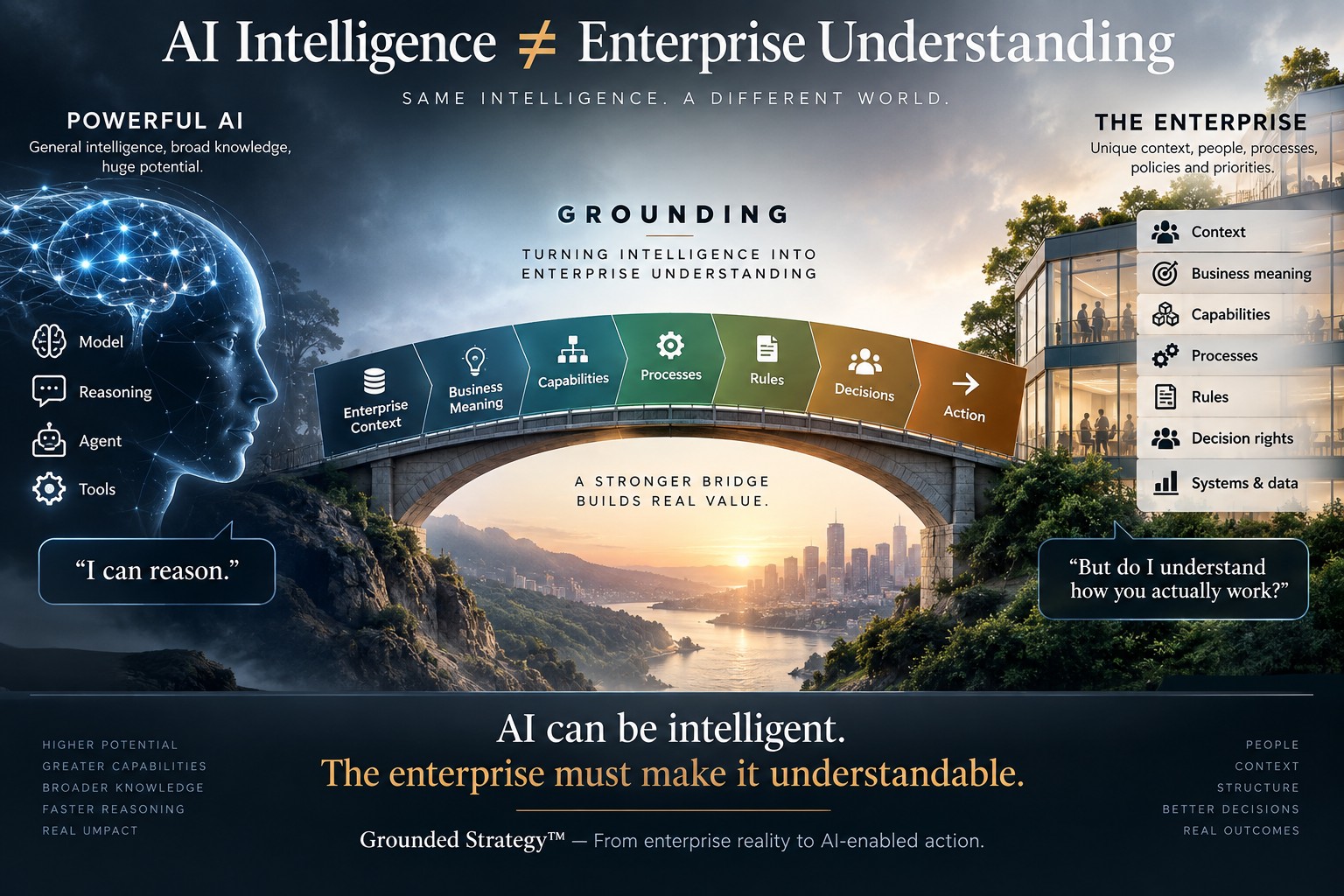
An AI agent may have:
🧠 A powerful model
💡 Strong reasoning
🤖 Agent capabilities
🔧 Access to tools
It may be able to reason about almost anything.
But enterprise execution requires something more.
Enterprise Context → Business Meaning → Capabilities → Processes → Rules → Decisions → Action
This is where many AI initiatives encounter a hidden bottleneck.
Consider a simple customer-service example.
A general AI may know:
“Refunds are normally permitted under these conditions.”
But an enterprise agent needs to understand:
Our company allows this customer segment to receive a refund only under this policy, through this process, with this approval authority, using this system, unless this exception applies.
That is a completely different level of understanding.
The difference is not simply:
Knowing the answer
versus
Not knowing the answer.
It is:
Knowing the answer
versus
Knowing how this enterprise works.
And this is where Business Architecture becomes highly relevant to AI.
Capabilities define what the enterprise can do.
Processes define how work is performed.
Rules constrain what can happen.
Decision rights define who—or what—can make decisions.
Business meaning connects these elements to strategic intent.
Without this structure, an AI agent may be highly intelligent while still operating with an incomplete understanding of the organization.
This is also why I believe enterprise knowledge architecture will become a strategic asset.
The challenge is no longer only:
“Which AI model should we use?”
It increasingly becomes:
“Have we structured the enterprise knowledge required for AI to act correctly?”
This is one of the reasons I created Grounded Strategy™.
The objective is not to make AI more intelligent.
The objective is to make enterprise reality understandable and actionable for AI.
The architecture begins with enterprise reality and connects it to strategic meaning, capabilities, execution logic and ultimately action.
AI Intelligence → Enterprise Context → Business Meaning → Capabilities → Processes → Rules → Decisions → Action → Business Outcome
Pinecone is highlighting a problem that is becoming increasingly visible as organizations move from AI experimentation toward agentic execution.
The strategic question therefore changes.
It is no longer simply:
Who has the smartest model?
It becomes:
Who understands its own enterprise well enough to make that understanding usable by both humans and AI?
That may become one of the defining sources of competitive advantage in the next stage of enterprise AI.
AI can be intelligent.
The enterprise must make it understandable.
Grounded Strategy™
From enterprise reality to AI-enabled action.
#AI #AIGovernance #BusinessArchitecture #AgenticAI #EnterpriseAI