
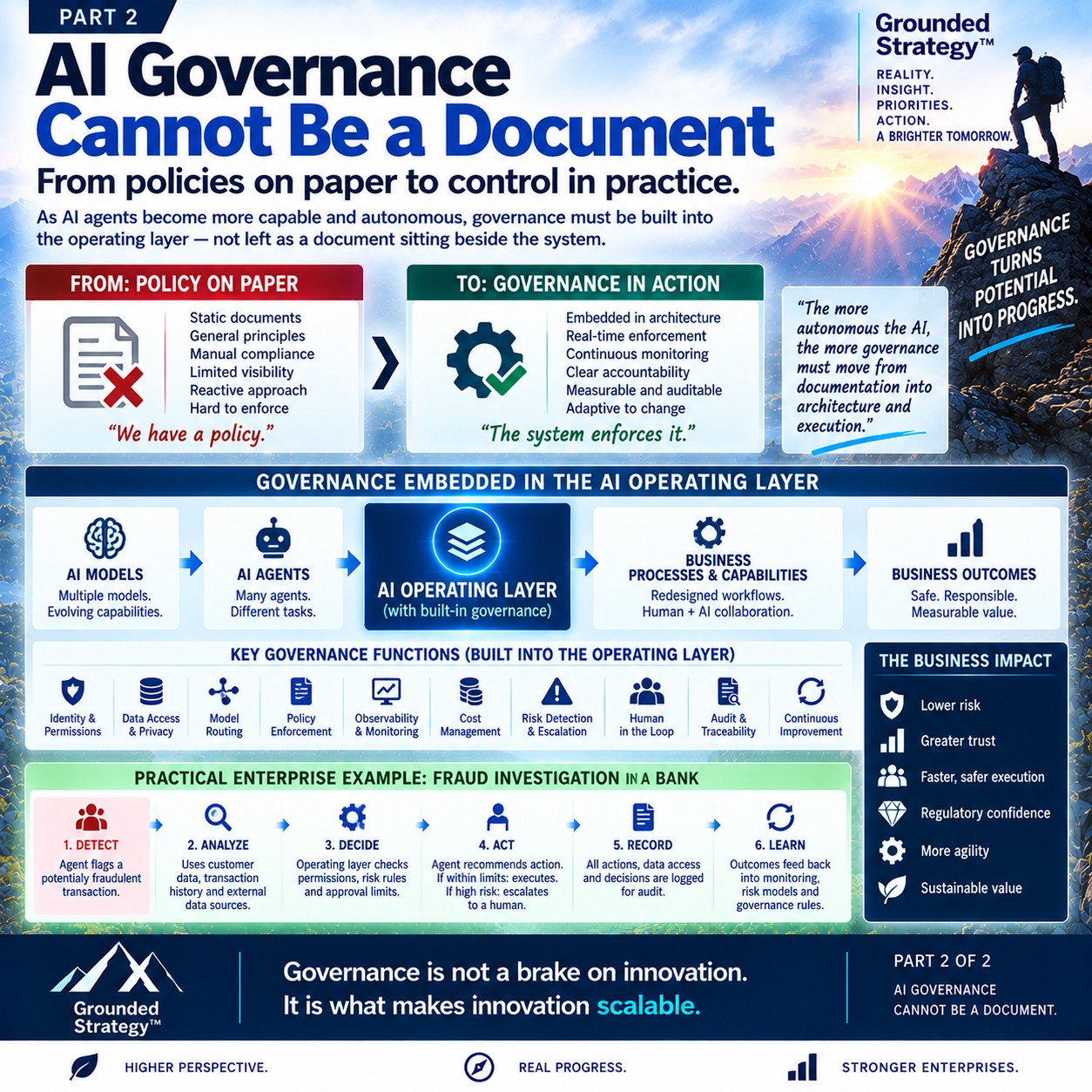
As AI agents become more capable and autonomous, governance becomes more important.
But there is a fundamental problem with treating governance only as policy.
A document can say:
“Agents must have appropriate permissions.”
But the system must enforce those permissions.
A policy can say:
“High-risk decisions require human approval.”
But the workflow must actually stop the agent and request approval.
A policy can say:
“AI activity must be monitored.”
But the architecture must actually observe, record and escalate what happens.
This leads to a simple principle:
AI governance cannot be a document sitting beside the system.
Governance must move:
From policy → to architecture → to execution.
A practical enterprise example
Imagine a bank using an AI agent for fraud investigation.
The agent detects a suspicious transaction.
It can:
detect → investigate → analyze → recommend → act
But the AI Operating Layer determines:
- What data can the agent access?
- Which risk rules apply?
- What actions is it authorized to perform?
- What transaction value requires human approval?
- When must the case be escalated?
- How is every action recorded for audit?
And after the case is closed:
What did we learn, and should the rules or monitoring change?
That is governance in action.
The important shift is:
Governance is no longer simply something the enterprise tells the AI to follow.
It becomes something the enterprise builds into the way AI operates.
This requires capabilities such as:
→ Identity and permissions
→ Data access and privacy
→ Policy enforcement
→ Risk detection
→ Observability and monitoring
→ Human escalation
→ Audit and traceability
→ Continuous improvement
And this creates a direct connection between:
AI Models → Agents → AI Operating Layer → Business Processes → Business Capabilities → Outcomes
The more autonomous the AI becomes, the more governance must move into the architecture itself.
This is not about slowing innovation.
It is about making innovation safe, scalable and trustworthy.
And this is where Business Architecture becomes important.
We need to design not only what AI can do, but also:
- where it can act,
- how it can act,
- what it needs to know,
- who remains accountable,
- and how the enterprise learns from its actions.
The future enterprise will not simply need AI capability.
It will need the capability to govern AI continuously.
Because:
Governance is not a brake on innovation.
It is what makes innovation scalable.
#AI #AIGovernance #AIAgents #BusinessArchitecture #OperatingModel #EnterpriseArchitecture #Cybersecurity #BusinessTransformation #Strategy #GroundedStrategy