The AI model race is moving incredibly fast.
But enterprises are beginning to face a different problem:
What happens when we have hundreds—or thousands—of AI agents?
- Different models.
- Different vendors.
- Different agents.
- Different workflows.
- Different levels of autonomy.
Who manages them?
Who controls them?
Who knows what they are doing?
Who decides what they are allowed to do?
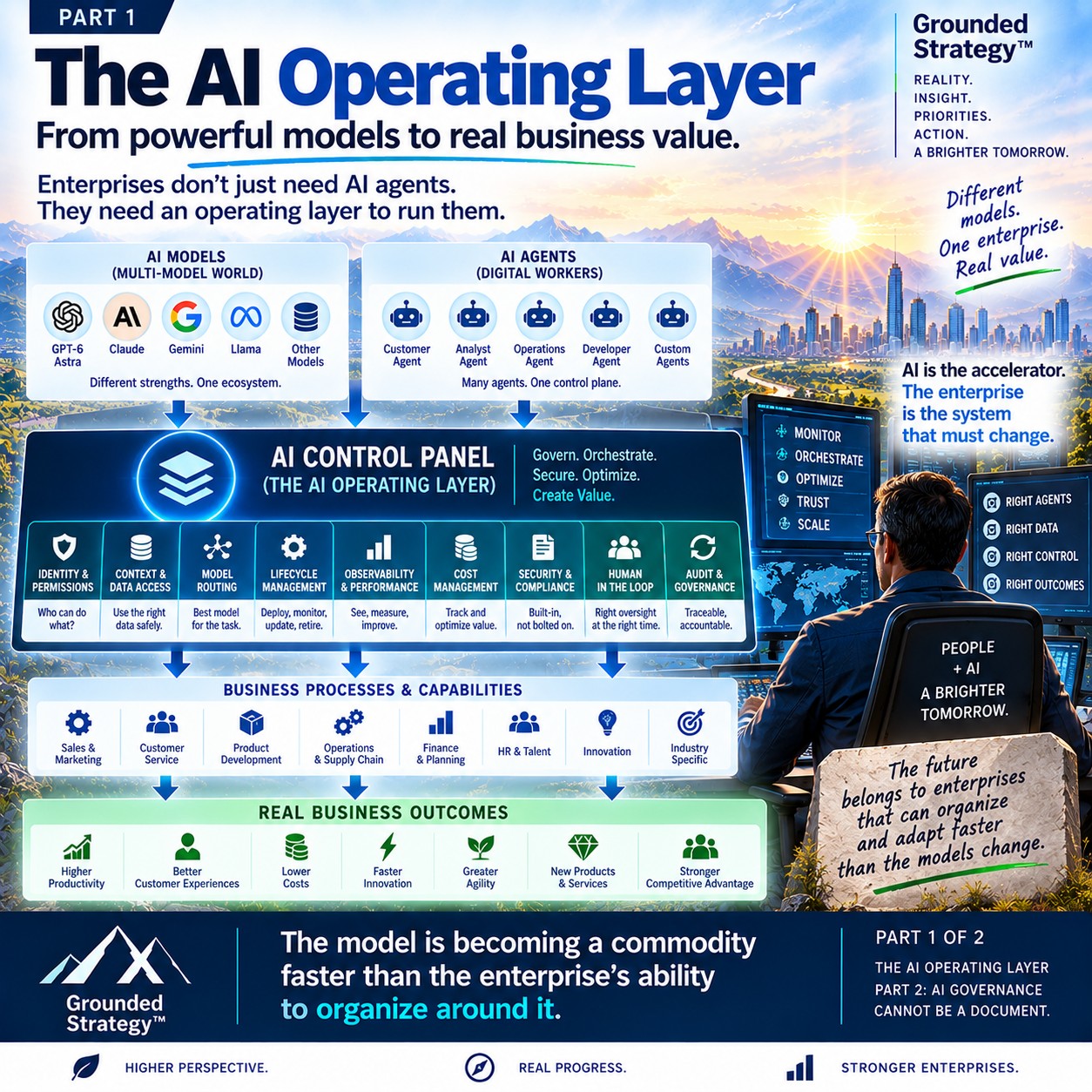
This is where I believe a new enterprise capability is emerging:
The AI Operating Layer.
It sits between AI models and business execution.
AI Models → AI Agents → AI Operating Layer → Processes & Capabilities → Business Outcomes
The operating layer could become responsible for:
→ Identity and permissions
→ Context and data access
→ Model routing
→ Agent lifecycle
→ Observability and performance
→ Cost management
→ Security and compliance
→ Human-in-the-loop controls
→ Audit and governance
A practical enterprise example
Imagine a large bank with 300 AI agents across customer service, fraud, lending, finance and operations.
A customer-service agent wants to resolve a disputed transaction.
The agent can:
access customer information → investigate the transaction → contact internal systems → recommend a resolution → potentially issue a refund.
But the AI Operating Layer determines:
Who is this agent?
Is it authorized to access this customer’s data?
What can it do?
Can it recommend a refund or actually execute one?
How much authority does it have?
Can it approve €50, €500 or €50,000?
Which model should it use?
A lower-cost model for routine cases? A stronger model for complex investigations?
When must a human intervene?
For high-value, unusual or regulated cases?
What happens when something goes wrong?
Is the action stopped, escalated and recorded?
Can the enterprise prove what happened later?
Every decision, data access and action should be traceable.
Now imagine doing this consistently across 300 agents.
That is no longer an AI-project problem.
It is an enterprise operating capability.
And this is where Business Architecture becomes important.
We need to understand:
- Which business capabilities should use agents?
- Which value streams should be redesigned?
- Which decisions can be delegated?
- Which controls must remain human?
- How should accountability change?
The enterprise may therefore need:
AI Models + AI Agents + AI Operating Layer + Business Architecture + Governance
The goal is not simply to deploy more agents.
The goal is to create an enterprise where agents can operate safely, economically, measurably and at scale.
Because the model will change.
The agent will change.
The vendor will change.
The cost will change.
The enterprise needs an architecture that can absorb that change.
And perhaps the most important observation is this:
The model is becoming a commodity faster than the enterprise’s ability to organize around it.
The future competitive advantage may therefore belong to enterprises that can organize, govern, integrate and adapt AI faster than their competitors.
That is not just an AI problem.
It is a Business Architecture and Operating Model problem.
#AI #AIAgents #BusinessArchitecture #OperatingModel #EnterpriseArchitecture #AIGovernance #Cybersecurity #BusinessTransformation #Strategy #GroundedStrategy